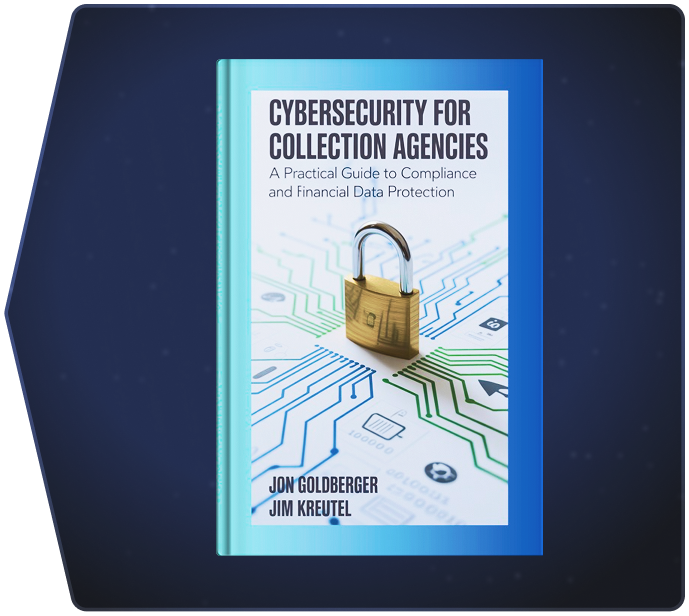
This book helps collection agencies navigate the complex environment confidently. It offers actionable guidance on strengthening cybersecurity while complying with regulations like the GLBA Safeguards Rule, grounded in real-world best practices.
Empower your agency with essential cybersecurity insights.
by Jonathan Goldberger (Author), James Kreutel (Author)
But beyond compliance and defense, there is another compelling reason to take cybersecurity seriously: trust. In a highly competitive market, clients and consumers increasingly seek partners who can prove they take data protection seriously. A well documented cybersecurity program can differentiate your firm, win new business, and build long-term client relationships. Security is no longer just about avoiding risk—it’s about enabling growth and inspiring confidence.
Why cybersecurity is the #1 priority for modern collection agencies
In an era where financial data is the primary target for cybercriminals, collection agencies find themselves in a high-risk position. Managing Non-Public Personal Information (NPI) isn’t just a business process; it’s a massive responsibility.
A single data breach can lead to:
Irreversible reputational damage: Losing the trust of both creditors and consumers.
Devastating financial penalties: Fines that can exceed the annual revenue of mid-sized firms.
Operational downtime: Ransomware attacks can paralyze your recovery efforts for weeks.
Navigating the GLBA Safeguards rule and financial regulations
Compliance is no longer optional. The updated FTC Safeguards Rule requires non-banking financial institutions, including debt collectors, to maintain a comprehensive information security program.
Our guide, Cybersecurity for Collection Agencies, breaks down these complex requirements into actionable steps. We cover:
Risk assessments: How to identify where your sensitive data lives.
Access controls: Implementing "Least Privilege" protocols to protect debtor information.
Encryption standards: Ensuring data is unreadable even if intercepted during transmission.
Incident response planning: Being prepared for the "when," not just the "if."
What you’ll learn in this practical guide
Written by industry experts Jonathan Goldberger and James Kreutel, this book serves as a roadmap for agency owners and IT managers.
Proactive defense: Move beyond basic firewalls to a holistic security posture.
Vendor management: Learn how to vet third-party partners who may have access to your network.
Employee awareness: Turn your staff from your weakest link into your strongest line of defense against phishing.
Scalable security: Cybersecurity strategies that grow as your agency acquires more portfolios.
Our Services
Cybersecurity for debt collection: frequently asked questions
Does the GLBA Safeguards rule apply to small collection agencies?
Yes. The rule applies to all financial institutions under FTC jurisdiction, regardless of size, that are significantly engaged in financial activities like debt collection.
How often should my agency perform a cybersecurity audit?
At a minimum, an annual comprehensive risk assessment is required, but continuous monitoring is the gold standard for modern financial data protection.
What is the first step to improving our security posture?
Education and assessment. Understanding your current vulnerabilities is essential before investing in expensive software solutions.